
Do you need a permit to renovate in Portugal? The 3-category rule every expat gets wrong
By Kellogg Fairbank · Co-founder of remodel.pt · Last updated August 2026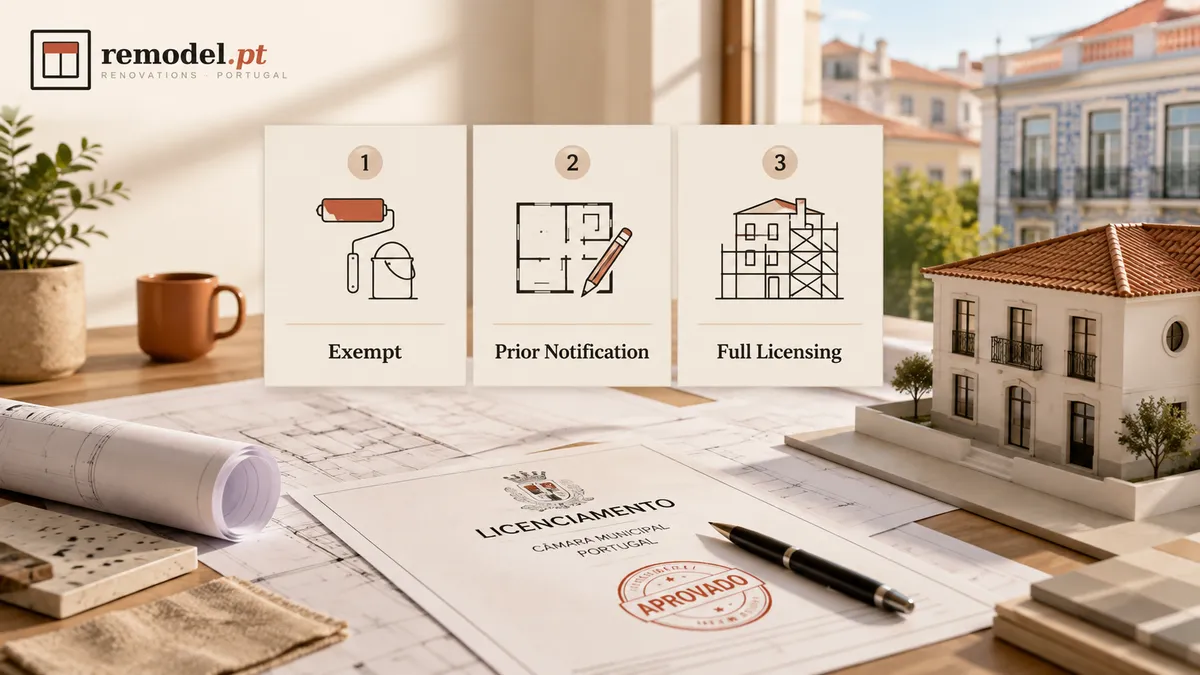
What's in this guide
- The three permit categories under the RJUE, and which one covers a typical kitchen or bathroom refit
- Which renovation work qualifies as obras de conservação and needs no permit or notification at all
- What comunicação prévia (prior notification) covers, including typical câmara municipal processing windows of 20 to 45 days
- Which structural or façade changes trigger full licenciamento, with approval timelines that can run 60 to 120 days
- How remodel.pt's vetted contractors classify a project's permit category before any quote is issued
What are Portugal's three renovation permit categories?
Exempt
Obras isentas
Maintenance and cosmetic work that doesn’t touch structure, layout, or external appearance: tile, floors, paint, fixtures, like-for-like windows.
No filing
Prior Notification
Comunicação prévia
Internal layout, plumbing, or electrical changes that don’t alter structure or external volume: most kitchen and bathroom rebuilds.
20–45 days
Full Licensing
Licenciamento
Load-bearing changes, added footprint or height, façade alterations, or a change of registered use.
60–120 days
Foreign owners tend to sort projects by budget: a €12,000 bathroom feels minor, so it must be exempt. A €48,000 kitchen refit feels major, so it must need a licence. The câmara municipal doesn't classify by price. It classifies by whether the work changes load-bearing structure, external appearance, or the building's registered use. A €12,000 bathroom that moves a wall between a bedroom and bathroom can require the same comunicação prévia as a much larger project, while a €48,000 kitchen refit that keeps every wall in place may need nothing filed at all.
Category 1: Which renovations need no permit at all?
A property owner in Sintra replacing kitchen cabinetry, worktops, and appliances without touching plumbing runs or walls stays in this category regardless of cost. The same applies to re-tiling a bathroom, replacing windows with matching dimensions, or repainting a façade in its existing colour. The caderneta predial (the property's tax and description record) doesn't change, and the câmara municipal has no filing to review.
Category 2: What is prior notification (comunicação prévia)?
Moving a non-structural wall to open a kitchen into a living room, relocating a bathroom's plumbing to a different corner of the room, or rewiring a full apartment all sit here. The owner or their architect files a project with the câmara municipal, the municipality has a set window to raise objections, and if none arrive, work can proceed. Cascais and Lisboa municipalities generally process comunicação prévia filings faster than smaller inland câmaras, where the same filing can take closer to the full 45-day window.
Category 3: Which projects require full licensing (licenciamento)?
Removing a load-bearing wall to create an open-plan ground floor, adding a dormer or extending a roofline, enclosing a balcony, or converting a garage into livable space all require full licenciamento. A licensed architect and, depending on scope, a structural engineer (Ordem dos Engenheiros) must prepare and stamp the project. Properties in zonas históricas face additional heritage review layers that routinely add 30 to 60 days on top of standard timelines, and can restrict façade materials and window proportions regardless of what the owner prefers.
Why do foreign owners get this wrong so often?
Foreign owners misjudge permit categories because Portuguese municipal classification rules aren't published in English and don't map onto renovation logic from other countries, where permit thresholds are usually tied to project cost or square footage rather than structural impact. An owner who renovated in the UK or the US brings an intuition that doesn't transfer, since Portugal's câmara municipal system draws the line at what the work touches, not what it costs.
The language barrier compounds the problem. Municipal guidance documents use terms like alvará, licenciamento, and comunicação prévia without English equivalents, and a Portuguese-speaking contractor may not think to explain the distinction to a client who's never encountered it. By the time an inspector or a buyer's due diligence surfaces an unregularised change, the owner has already paid for work that has to be redone, refiled, or reversed.
How does remodel.pt handle permit classification?
remodel.pt matches owners with alvará-verified, IMPIC-checked contractors who work from that classification rather than guessing at it after the fact. For projects that fall into comunicação prévia or licenciamento, remodel.pt's process routes the scope through contractors who already work with licensed architects on the relevant câmara municipal filings, so the paperwork and the renovation timeline move together instead of stalling each other.
Frequently asked questions
Conclusion
The three-category system exists to match the level of municipal review to what a renovation actually changes, not to what it costs. A kitchen refit that keeps the walls in place can move forward with no filing, while a smaller project that shifts plumbing or opens a wall needs comunicação prévia, and anything touching structure, façade, or use needs full licenciamento with a timeline to match. Classifying the project correctly before hiring anyone is what keeps a renovation on schedule and keeps the property sellable afterward.
Related reading: What is an alvará? · The 1951 rule explained · Bathroom renovation permits · DL 97/2026 renovation VAT · Renovation passport (EPBD) · Full renovation cost in Portugal

Kellogg is a former payments executive turned entrepreneur, with a family background in real estate. He has spent the past year bringing that experience to the Portuguese property market, and co-founded remodel.pt to apply the same rigor to how contractors are vetted.