
The 1951 Rule in Portugal: What It Actually Means for Your Renovation
By Pascal Niggli · Co-founder of remodel.pt · Last updated July 2026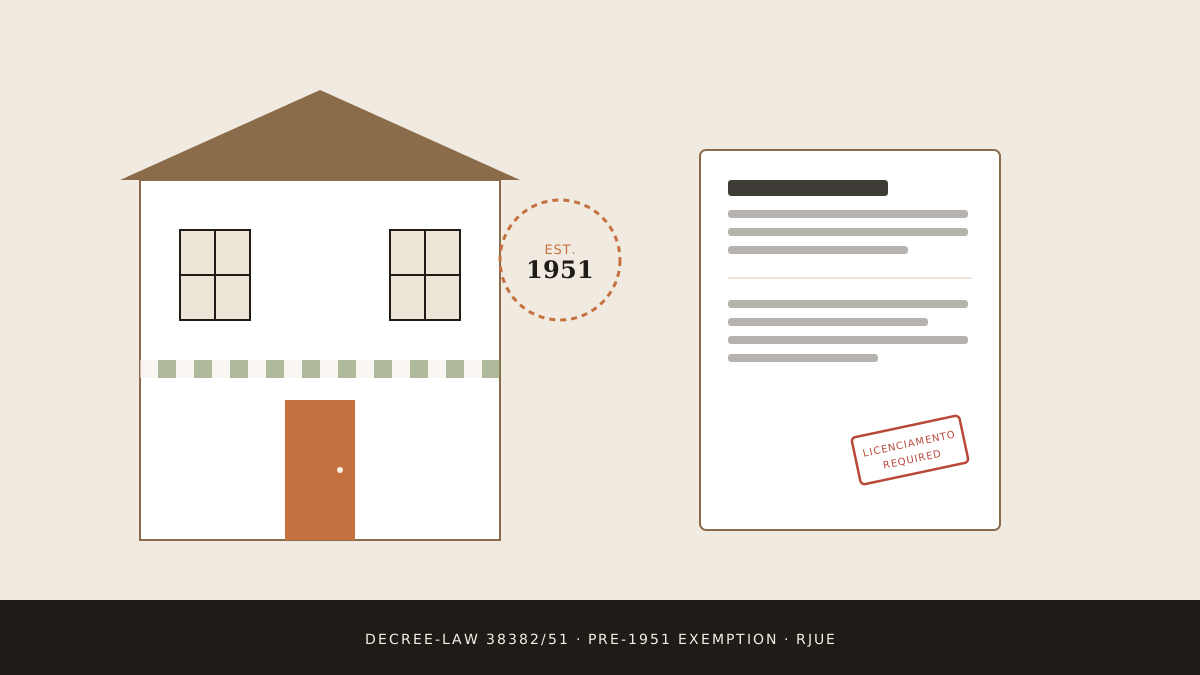
What's in this guide
- Decree-Law No. 38382/51 of August 7, 1951 created Portugal’s first building permit requirement (RJUE)
- Pre-1951 exemption certificates are issued locally, and the cutoff date can shift to the 1970s depending on the câmara municipal
- Any structural alteration to a pre-1951 property can trigger full licenciamento, voiding the exemption
- DL 10/2024 (Simplex Urbanístico) removed the notary-stage check on usage licences as of January 1, 2024
- Independent pre-renovation surveys typically cost far less than the fines or demolition orders tied to unauthorised construction
What Is the 1951 Rule?
Before August 1951, a Portuguese property owner could build a farmhouse, a townhouse, or a stable without submitting anything to a municipal authority, because no such authority reviewed construction. Decree-Law No. 38382/51 changed that. It required, for the first time, a building permit (licenciamento) for new construction, and it applied first to urban centres before being extended, municipality by municipality, over the following decades.
The practical consequence for today's buyer: any property completed before that date sits outside the permit regime entirely, because the regime didn't exist yet when it was built. Any property completed after it is expected to hold a usage licence (licença de utilização) or the paperwork trail proving it went through the process.
This is the entity foreign owners hear referenced as the "pre-51 certificate", a declaration issued by the câmara municipal (municipal authority) confirming a property predates the law, drawn from records like the caderneta predial (property tax record).
Why Foreign Owners Get This Wrong
Language barrier, opaque paperwork, and a market where "it's a pre-51, it's fine" gets repeated by sellers and agents alike, this is where the 1951 rule becomes a liability rather than a fact. Foreign owners commonly hear the phrase "pre-51" used as shorthand for "no regulation applies," and that shorthand is where problems start.
An owner who renovates on the assumption that a pre-1951 property is "off the grid" of Portuguese regulation can end up with unauthorised construction, câmara municipal fines, or an inability to obtain financing or resell.
How Does the Pre-1951 Exemption Actually Work?
There is no national pre-51 database an owner can simply check. The certificate is a local administrative act, and its rules are not uniform:
| Factor | What It Means |
|---|---|
| Cutoff date shifts by council | Some municipalities issue pre-51 style exemption certificates for buildings completed well into the 1970s, since the requirement wasn't extended nationwide on the same day. |
| Faro & Loulé exception | A separate declaration applies to buildings built after 1951 but before the local Plano Diretor Municipal (PDM), a middle category treated similarly to pre-51. |
| Proof source | Runs through the caderneta predial, supplemented where needed by câmara municipal archive research. |
| Financing impact | Portuguese banks routinely ask for a pre-51 certificate before approving a mortgage on an older property, without one, the loan process stalls. |
For a foreign owner buying remotely, this means the 1951 rule is not a fact you confirm once. It's a document you obtain, from a specific council, and its validity depends on the building staying exactly as it was.
What Happens When You Renovate a Pre-1951 Property?
This is the point where the 1951 rule most often costs foreign owners money. A pre-1951 certificate remains valid whilst no alterations have been made to the house, the moment structural work begins, the property can be pulled back into the full permitting regime (RJUE, Regime Jurídico da Urbanização e da Edificação), the same framework that governs any modern construction project.
Practical thresholds that typically require câmara municipal approval on a pre-1951 property:
Structural changes to load-bearing walls, floors, or roof structure
Façade alterations, including window or door repositioning
Any change of use (e.g., converting a stable or barn into habitable space)
Extensions to the existing building envelope
Kitchen Refit
Stays within existing walls, no structural work, typically doesn't reopen the permit question.
Full Renovation
Gutted floor plan, new plumbing risers through slabs, or converted outbuilding, almost always triggers licenciamento. Heritage zones (zonas históricas) can double the timeline.
Planning work on an older Portuguese property? See how remodel.pt matches you with alvará-verified contractors and an independent pre-renovation survey before you sign anything. → Request a Pre-Renovation Survey
Has the Law Changed Recently?
For a foreign buyer, this is a meaningful shift. The pre-51 question used to be a hard checkpoint enforced by a notary before a deed could be signed. It's now a disclosure, which means due diligence on a property's licensing status, pre-1951 or otherwise, is the buyer's responsibility earlier and more explicitly than it used to be. Verifying a property's status before renovating, not after signing a construction contract, is now the owner's problem to solve.
How remodel.pt De-Risks a Pre-1951 Renovation
A pre-1951 property is exactly the case where an independent condition report earns its cost. Before any contractor touches the building, a qualified inspector documents the existing structure, flags likely permit triggers, and establishes the baseline the câmara municipal will expect to see referenced if licenciamento becomes necessary partway through the project.
None of this changes whether a given wall requires a permit. It ensures the owner knows the answer before the first stone comes out.
Frequently Asked Questions
Conclusion
The 1951 rule is a real exemption with real limits, and it rewards precision, not shorthand. Knowing your property's construction date matters less than knowing what happens the moment you start renovating it. For most foreign owners, the safest starting point is the same regardless of the building's age: an independent survey, a verified contractor, and a clear answer on permitting before the budget is committed.
Related reading: Do you need a permit to renovate? · IMT, IMI and renovation tax · DL 97/2026: does the 6% VAT apply to you? · Bathroom renovation permits · Finding an English-speaking contractor · Full renovation cost in Portugal

Pascal is the co-founder of remodel.pt. Originally from Switzerland, he has lived in Portugal for several years and has first-hand experience with the permit, VAT, and contractor issues property owners run into. He built remodel.pt to be the resource he wished existed when he started.