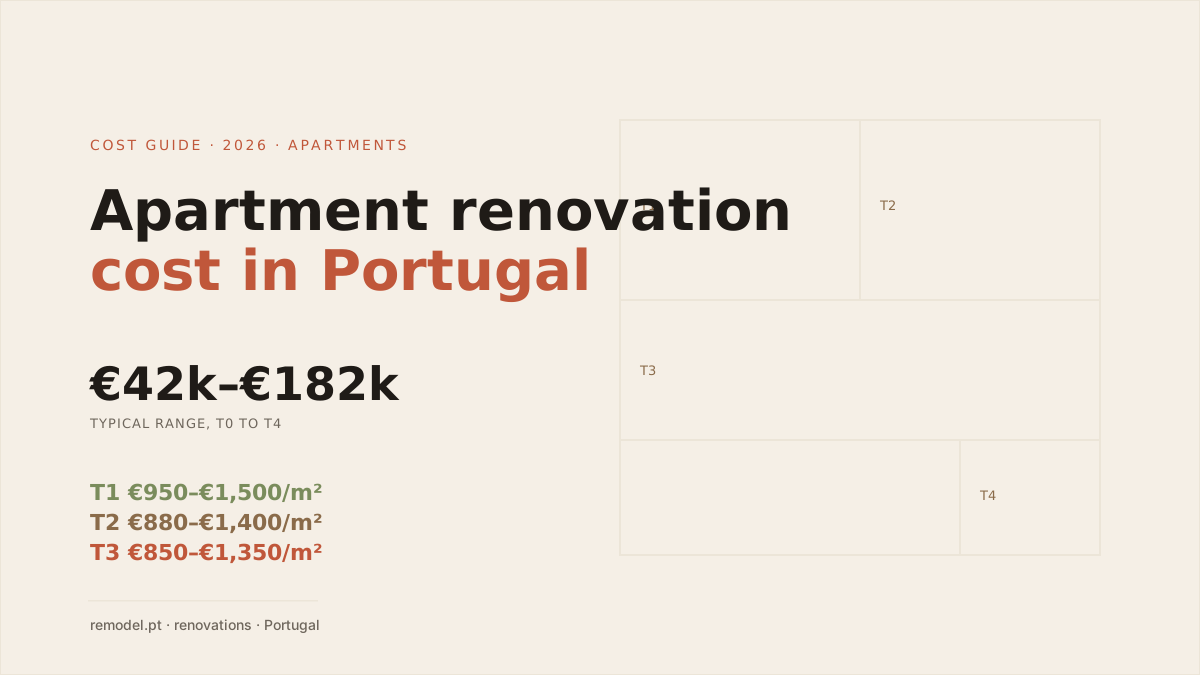
Renovating an apartment in Portugal costs €820 to €1,650 per square metre in 2026, with the rate falling as the unit gets bigger: a T0 studio typically runs €42,000 to €66,000 total, a T2 runs €70,000 to €112,000, and a T4 runs €115,000 to €182,000. The per-m² rate is highest for the smallest units, because a kitchen and bathroom cost about the same to fit regardless of the apartment's size.
T2 (70–90m²)
€70k–€112k
Smallest units
Cost more /m²
Typical duration
8–26 weeks
Vetted quotes
3
Most renovation cost guides quote a single €/m² figure and call it done. That number hides the single biggest variable in apartment renovation economics in Portugal: unit size. A T0 studio and a T4 family apartment do not cost the same per square metre, because a kitchen and two bathrooms cost roughly the same to fit whichever apartment they go in. This guide breaks the cost down by typology, and covers the condominium realities that a generic full-house renovation guide does not.
Cost by apartment typology, T0 to T4
A mid-range full renovation runs from €42,000 for a T0 studio to €182,000 for a T4 apartment, based on remodel.pt contractor network data from 2025 to 2026 projects.
Source: remodel.pt project data · September 2026 · Full renovation to habitable standard, mid-range finish, excludes region-specific premiums
T0 (studio)
~35–45m²
€1,050–€1,650/m²
Per m²
€42,000–€66,000
Total
T1
~50–65m²
€950–€1,500/m²
Per m²
€55,000–€87,000
Total
T2
~70–90m²
€880–€1,400/m²
Per m²
€70,000–€112,000
Total
T3
~90–120m²
€850–€1,350/m²
Per m²
€89,000–€142,000
Total
T4
~120–160m²
€820–€1,300/m²
Per m²
€115,000–€182,000
Total
Regional variation still applies on top of these figures the same way it does for a full house: Lisboa's historic core and Cascais run 10 to 20% above these baselines, Porto runs 5 to 10% below, and inland municipalities run further below still. See the full renovation cost guide for the complete regional breakdown, since that variation works the same for apartments as for houses.
✓ NOTEThese figures include IVA at the standard Portuguese rate (23% for most renovation services, 6% for certain repair and maintenance work on residential properties older than two years).
Why smaller apartments cost more per square metre
A kitchen costs roughly €14,000 to €19,000 to fit at mid-range finish whether the apartment is 40m² or 140m², and a bathroom costs roughly €10,000 to €14,000 on the same logic. Those fixed costs make up a bigger share of a smaller unit's total.
A T0 studio has one kitchen and one bathroom absorbing perhaps €25,000 to €30,000 of fixed cost against a total floor area of 40m². A T4 apartment spreads two or three bathrooms and one kitchen, maybe €45,000 to €55,000 of the same fixed-cost categories, across 140m². The fixed-cost categories grow slower than the floor area does, so the per-m² rate falls as the unit gets bigger. This is standard renovation economics, not a Portugal-specific quirk, but it is worth knowing before comparing a T0 quote against a T3 quote on €/m² alone and assuming one contractor is overcharging.
What a T2 apartment renovation includes
A full T2 apartment renovation (80m², mid-range, one bathroom) covers structural and partition work, electrical rewiring, plumbing, kitchen and bathroom installation, flooring, carpentry, painting, and the waste and logistics costs specific to apartment buildings.
80m² T2 Apartment · Mid-range · ~€88,000 total
Kitchen (cabinets, countertops, appliances)
19–21%
€16,700–€18,500
Bathroom (1)
13–15%
€11,400–€13,200
Structural / partition changes
13–15%
€11,400–€13,200
Electrical rewiring
9–11%
€7,900–€9,700
Flooring
9–11%
€7,900–€9,700
Plumbing
8–10%
€7,000–€8,800
Carpentry (doors, built-ins, trim)
7–9%
€6,200–€7,900
Painting
5–7%
€4,400–€6,200
Waste removal & condominium logistics
4–6%
€3,500–€5,300
Finishing / cleanup
3–5%
€2,600–€4,400
Notice the last two lines. Waste removal and condominium logistics, and a one-bathroom scope instead of a house's typical two, are the two biggest structural differences between this breakdown and a comparable house renovation. Everything else scales the way you'd expect.
Worried about your apartment renovation quote?
remodel.pt sends the same written scope, floor access and condominium constraints included, to three alvará-verified contractors for an apples-to-apples comparison.
Apartment renovations answer to two authorities a house renovation doesn't: the condominium administration, and whatever regulamento do condomínio governs that specific building. Both can affect cost and timeline before the câmara municipal is even involved.
Administrator approval for structural work
Removing a partition wall, altering plumbing risers, or any work touching a shared wall typically needs sign-off from the condominium administration before a contractor can start, on top of any câmara municipal permit.
Refundable protection deposit
Many buildings require a caução, commonly €300 to €1,500, before allowing materials or waste through the stairwell, lift, or common entrance. Returned after a post-work inspection confirms no damage to common areas.
Restricted working hours
Most condominium regulations limit construction noise to weekdays, commonly 9am to 6pm, sometimes with reduced Saturday-morning hours and no work on Sundays or public holidays. This stretches the calendar timeline even when the labour itself is unaffected.
Lift and stairwell logistics
Some buildings require a goods lift booking or protective covering on the passenger lift before allowing material transport. Buildings without a lift add real labour time, since everything moves up and down by hand.
⚠ WARNINGStarting work that touches a shared wall, riser, or the building exterior without administrator sign-off can result in a stop-work order from the condominium, independent of any câmara municipal permit status. Confirm both before scheduling demolition.
How building age changes the price
A pre-1960 apartment costs 15 to 25% more to renovate than the typology baseline, mainly because a full rewire and replumb is close to certain rather than optional. A post-2000 apartment often costs 10 to 20% less, since the scope is frequently cosmetic only.
Pre-1960
+15–25% vs. baseline
Lime-mortar walls, timber floor joists common
Full electrical rewire almost always needed
Original plumbing usually beyond repair
Heritage-zone properties may need DGPC approval
Pombalino and gaioleiro buildings in Lisboa’s historic core fall here by default.
1960s–1990s
Baseline
Reinforced concrete construction, mixed condition
Wiring often undersized for modern appliance load
Original bathroom and kitchen plumbing usually dated
No structural surprises in most cases
The largest single cohort of apartments in Lisboa, Porto, and Cascais.
Post-2000
−10–20% vs. baseline
Wiring and plumbing meet current standards
Often cosmetic-only scope: kitchen, bathroom, finishes
Better sound and thermal insulation already in place
Condominium documentation usually more complete
Most common scope here is a kitchen and bathroom refresh, not a full renovation.
Hidden costs specific to apartments
Beyond the contingency every renovation should budget, apartment projects carry logistics costs a standalone house never sees, mainly tied to moving materials and waste through shared common areas.
01
Condominium protection deposit€300–€1,500
Refundable, but the cash has to be available upfront, and the timing of its return depends on the administration’s own inspection schedule, not the project’s.
02
Vertical logistics (no lift, or lift booking fee)€500–€2,000
Hand-carrying materials and waste up a walk-up building, or booking a goods lift where one exists, adds labour hours a ground-floor or house project doesn’t have.
03
Waste removal via licensed container€800–€2,500
A skip can’t sit on a private driveway the way it might for a house. Central buildings often need a street permit for a container, or bagged removal by hand, both of which cost more than a house’s single skip.
04
Shared-riser plumbing or electrical coordinationVariable
Work touching a shared pipe or electrical riser sometimes needs coordinated access to a neighbouring unit, which can add scheduling delay even when it adds little direct cost.
05
Contingency10–20% of quote
Pre-1960 buildings in particular produce surprises once walls open: degraded wiring, corroded pipes, unauthorised past work. Budget 10 to 15% contingency generally, 15 to 20% for pre-1960 apartments.
i TIPAsk for the condominium's protection-deposit and working-hours rules before a contractor quotes, not after. Most of the logistics costs above are foreseeable if someone asks the administration the right questions early.
How long an apartment renovation takes
A T0 or T1 apartment with no structural work takes 8 to 12 weeks. A T3 or T4, or any unit with structural changes, takes 18 to 26 weeks. Condominium restrictions add 3 to 6 weeks on top of either.
T0 / T1 (no structural work)8–12 weeks
T2 (some partition changes)12–18 weeks
T3 / T4, or any structural work18–26 weeks
Condominium-restricted or heritage building+3–6 weeks
Permit processing, where structural work is involved, runs on top of this and follows the same 60 to 120 day câmara municipal timeline as any other renovation. Condominium restrictions are the apartment-specific addition: buildings that only allow work Monday to Friday, 9am to 6pm, effectively lose weekends a house project would otherwise use, and administrator approval for structural work can add 2 to 6 weeks before a single wall comes down.
How foreign owners avoid overpaying
Foreign apartment owners face the same pricing disadvantage as house owners, plus one more variable specific to apartments: quotes that don't account for floor access or condominium logistics tend to grow mid-project rather than shrink.
1
Get the condominium’s rules in writing before quoting
Working hours, deposit requirements, and what needs administrator sign-off vary by building, and a quote built without this information gets revised once the contractor reads the regulamento do condomínio.
remodel.pt asks for the condominium’s rules as part of scoping, before quotes go out, not after.
2
Confirm the quote accounts for floor and lift access
The identical T2 apartment costs measurably more to renovate on a fourth floor with no lift than on the ground floor of the same building. This is one of the most common places quotes vary without the owner understanding why.
Every remodel.pt scope document states floor, lift access, and any condominium logistics constraints up front.
3
Insist on staged payments tied to inspection
Never pay more than 10 to 15% upfront. Structure payments around milestones, demolition, rough-in, tiling, kitchen install, final punch list, each signed off before the next payment releases.
remodel.pt ties payment releases to independent inspection verification at each milestone.
Frequently asked questions
A T2 apartment (roughly 70-90m²) costs €70,000 to €112,000 for a mid-range full renovation in 2026, at €880 to €1,400 per square metre depending on region and finish level.
A kitchen and bathroom cost roughly the same to fit whether the apartment is 40m² or 140m², so those fixed costs make up a larger share of a smaller unit’s total. A T0 studio typically runs €1,050 to €1,650/m², well above the €850 to €1,350/m² a T3 apartment sees for the same finish level.
Yes. Many administrations require a refundable protection deposit before allowing material transport through common areas, restrict working hours to weekdays, and require sign-off before any work touching shared walls, risers, or the building exterior.
Yes, materials and waste have to be hand-carried up and down stairs instead of moved by lift, which adds labour time. On a walk-up building above the second floor, contractors commonly add 5 to 10% to the labour portion of a quote.
A T0 or T1 apartment with no structural work takes 8 to 12 weeks. A T2 with some partition changes takes 12 to 18 weeks. A T3 or T4, or any unit with structural work, takes 18 to 26 weeks. Add 3 to 6 weeks where the condominium restricts working hours or requires administrator sign-off.
Yes. Buildings from before 1960 usually need a full rewire and replumb as a matter of course, which pushes cost 15 to 25% above the baseline. Buildings from 1960 to 2000 vary. Apartments built after 2000 more often need cosmetic work only, running 10 to 20% below baseline.
Some renovation and repair work on residential properties older than two years qualifies for a reduced 6% VAT rate instead of the standard 23%, under conditions set out in DL 97/2026. Whether a specific project qualifies depends on the scope; see the dedicated DL 97/2026 guide for the detail.
Get quotes from vetted contractors
Average apartment renovation in Portugal: €42,000 to €182,000 depending on typology. Staged milestone payments. Independent inspection at every stage. Free for property owners.
Pascal is the co-founder of remodel.pt. Originally from Switzerland, he has lived in Portugal for several years and has first-hand experience with permit, VAT, and contractor issues foreign owners run into. He built remodel.pt to be the resource he wished existed when he started.
This guide provides general cost information based on remodel.pt contractor network data. Actual renovation costs vary by property condition, scope, materials, and contractor. This is not a substitute for a detailed scope assessment and written quotation from a licensed contractor. Permit, condominium, and tax information is general guidance, not legal or fiscal advice. Consult a licensed architect and tax advisor for your specific project.
Last updated: September 2026
We use cookies to understand how visitors use this site and improve your experience. See ourCookie Policyfor details.