New build & renovationContractor disputesProject recovery12 min read
Contractor stopped work in Portugal? What to do when your building project goes wrong
You have paid most of the contract. The house is only partly built. The site is going quiet. Here is how to find out where you really stand before you make it worse.
By Kellogg FairbankUpdated 7 October 2026
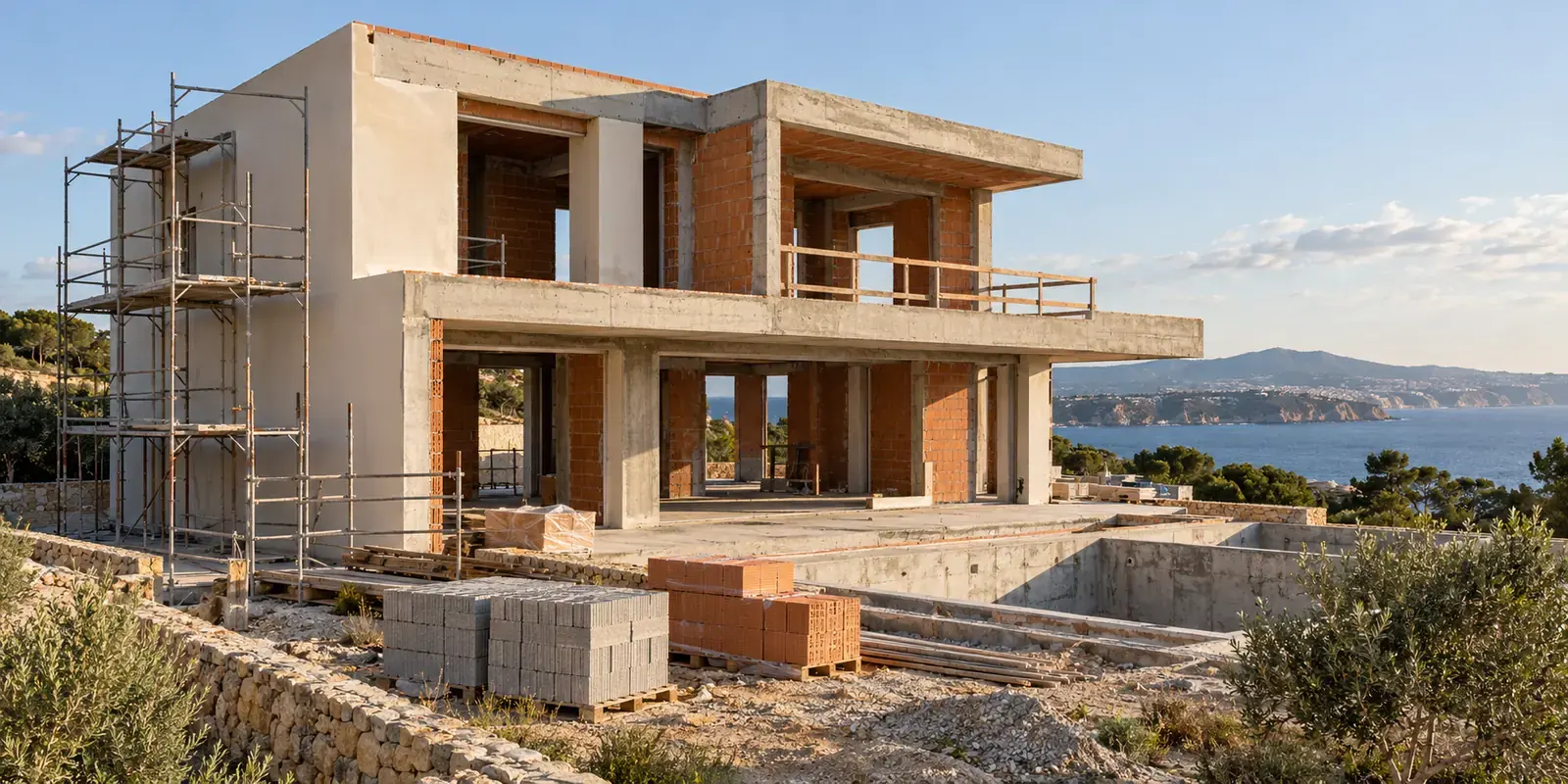
A stalled new build: frame and walls up, pool shell poured, materials waiting and nobody on site.
The short answer
Stop paying, get an independent assessment of what is built and what it will cost to finish, document everything, then take legal advice before terminating.
90% / 60%Money paid versus house built in the scenario this guide works through
€135k+Potential funding gap on an illustrative €400,000 build
IMPICRegulator of construction activity; the alvará class sets the maximum value of works
Step 2An independent project assessment, before you pay, terminate or rehire
Figures are illustrative and drawn from the worked example below.
You've paid the contractor. The work isn't finished.
In brief
When payments are not tied to milestones, owners can pay nearly the full contract while the house is only around 60% built.
You bought a plot of land in Portugal. You found an architect, got the approvals and started looking for someone to build your house. Several contractors quoted. You chose one. The price looked reasonable, the contractor seemed experienced, and the work started well.
There was one problem. The contract didn't properly connect payments to construction milestones. Over the following months you paid invoice after invoice, until almost the entire contract value had gone. Your house is around 60% complete.
Then progress slows.
5On site
2Weeks later
1Then
0Some weeks
Calls aren't returned as quickly. Messages become vague.
We'll have the team back next week.Contractor, WhatsApp
Next week comes and nothing happens. You have paid for a house that hasn't been built.
This is the point where owners can make a difficult situation worse. The instinct is to threaten the contractor, terminate on the spot or hire someone else. Before you do any of those things, you need to understand exactly where you stand.
First
Stop treating this as a contractor problem
In brief
A stalled, overpaid build is a project recovery problem. The goal is to establish facts about work, money and cost to complete, not to prove fault.
It is now a project recovery problem. Your objective isn't to prove that the contractor is terrible. It is to answer seven questions.
01
How much work has actually been completed?
02
How much money has been paid?
03
How much will it cost to finish the project?
04
What work has been paid for but not completed?
05
Are there defects in the work already performed?
06
Can the existing contractor realistically finish?
07
If not, how do you replace them without making it worse?
Until you can answer those, you don't know how serious the situation is.
Step 1
Don't send any more money
In brief
If payments are already ahead of progress, freeze further significant payments until you know exactly what the money already paid has bought.
If payments have moved well ahead of construction progress, the first priority is to stop that imbalance growing. A contractor may tell you:
We need another €20,000 to order the windows.Contractor
We need to pay the subcontractors before they return.Contractor
That might even be true. But sending more money into a distressed project without understanding its financial and construction position increases your exposure.
⚠
Atenção
Before making another significant payment, establish what you have already paid for.
Step 2
Get an independent assessment of the project
In brief
An engineer, architect, quantity surveyor or project manager with no link to the contractor should value completed work and price what remains.
This is probably the most important step. Bring in an independent construction professional, engineer, architect, quantity surveyor or experienced project manager who is not financially connected to the contractor. Their job is to establish the actual status of the project.
Imagine your original contract was €400,000. You've paid €360,000. The contractor says the project is almost finished. An independent assessment might find something very different.
Worked example, illustrative figures
Position
Amount
Original contract
€400,000
Amount already paid
€360,000
Estimated value of completed work
€240,000
Original contract remaining
€40,000
Estimated actual cost to complete
€175,000
Potential funding gap
€135,000+
Paid vs built vs cost to finish, €0 to €450k
What you paid
€360k
What exists on site
€240k
Built plus cost to finish
€240k
+€175k
PaidValue of completed workCost to completeDashed line: €400k contract
These numbers are illustrative, but they show why the assessment matters. The important number isn't the percentage complete.
What will it cost to get from where you are today to a completed house?
That becomes the basis for every decision that follows.
Step 3
Document everything
In brief
Gather every contract, invoice, payment, message and drawing, then photograph the whole site before relationships deteriorate and evidence becomes harder to obtain.
Before relationships deteriorate further, create a complete record of the project.
Contract & scope
Signed construction contract and appendices
Original quotations
Scope of works
Architectural and engineering drawings
Planning and licensing documentation
Change orders and additional-work agreements
Money
Invoices
Bank transfers and payment receipts
Communication
WhatsApp conversations
Emails
Any promises about completion dates
Site & progress
Construction schedules
Site reports
Photographs and videos
Materials purchased for the project
Materials currently stored on site
Details of subcontractors involved
Then photograph the entire project, not just the obvious unfinished areas.
WallsRoofWaterproofingElectricalPlumbingWindowsInsulationDrainageMaterialsEquipmentExternal works
If a dispute develops later, evidence matters.
Step 4
Check exactly who you contracted with
In brief
Confirm the legal entity named on your contract and verify with IMPIC that it holds the right alvará class for your project's value.
This sounds obvious. It often isn't. Was your contract with:
Person
The builder personally
Lda / SA
A Portuguese company
Developer
A development company
PM firm
A project management company
Abroad
A foreign company
You should also check the contractor's construction credentials.
§
Base legal
Portugal regulates construction activity through IMPIC. Depending on the nature and value of the works, contractors may need an appropriate alvará or certificate, and the class of an alvará relates to the maximum value of works the contractor is authorised to undertake.
Do not assume that because somebody has been building houses for years everything is in order. Verify it.
Step 5
Review the contract before terminating anything
In brief
Your contract may require a formal default procedure before termination. Have a Portuguese construction lawyer review it, because terminating incorrectly weakens your position.
This is where professional legal advice becomes important. Your contract may contain provisions covering:
Completion deadlinesPayment schedulesContractor defaultDelaysPenaltiesDefectsSuspension of workTerminationDispute resolutionNoticesVariations
If the contractor is in breach, there may be a formal procedure to follow before you terminate. Do not simply send a WhatsApp saying:
You're fired. Don't come back.
You may have legitimate reasons for ending the relationship, but terminating incorrectly can complicate your position. Have a Portuguese lawyer experienced in construction contracts review the agreement and advise on the next step.
Step 6
Put the problem in writing
In brief
Move from WhatsApp to provable communication, such as registered letter or email, setting out the facts and a deadline to respond.
At some point, informal WhatsApp conversations need to stop.
§
Base legal
The Direção-Geral do Consumidor recommends first trying to resolve disputes directly with the professional, using communication that can later be proven, such as registered post or email, and asking for a reply within a defined period.
Your letter should clearly establish the issues. For example:
Carta registada com aviso de receçãoRef: Obra / Contrato n.º ___
Amount paid to date
Current state of construction
Work outstanding
Contractual deadlines that have been missed
Defects identified
Documents or information required
Proposed corrective actions
Deadline for responding
Deadline to return to site or present a recovery programme
Structure only. Have your lawyer approve the final wording.
The purpose isn't to write an angry letter. It is to establish a documented position.
Step 7
Determine whether the contractor can actually recover the project
In brief
A capable contractor with a temporary problem can be faster and cheaper to keep, provided they commit to a written, week-by-week recovery plan.
This is one of the hardest decisions. Not every delayed project needs a new contractor. Sometimes the builder has hit a temporary cash-flow problem, a subcontractor issue, a materials delay or another project that has disrupted scheduling.
If the contractor can still complete the project, keeping them may be faster and less expensive than replacing them. But promises aren't enough. If you agree to continue, insist on a written project recovery plan.
Week 1
Roofing completedVerified before payment
Week 2
Windows installedVerified before payment
Week 3
First-fix electrical completedVerified before payment
Week 4
Plumbing completedVerified before payment
Week 5
Plastering beginsVerified before payment
Each stage needs a clearly defined deliverable. Future payments should then follow independently verified progress wherever possible.
Don't finance promises. Pay for verified progress.
Recovery may work when
The cause is a temporary cash-flow problem
A subcontractor or materials delay is the bottleneck
Another project disrupted scheduling
They sign a written recovery plan
Replacement is likely when
The site has effectively been abandoned
The business has serious financial problems
The relationship has broken down
Getting them to perform costs more than replacing them
Step 8
If necessary, prepare to replace the contractor
In brief
A new contractor inherits every unknown on a half-built site. The independent assessment must come before you hire contractor number two.
Sometimes recovery isn't realistic. But bringing another contractor onto a half-completed project creates its own challenges. The new contractor needs to understand:
CriticalWhat has been completed incorrectly
CriticalWhat the true completion cost is
CriticalWhat permits or inspections remain
CheckWhat has been completed
CheckWhat needs removing
CheckWhat materials remain
CheckWhat has already been ordered
CheckWhich subcontractors have been paid
CheckWhat warranties exist
This is why the independent assessment comes before hiring contractor number two. Otherwise you risk replacing one uncertain situation with another.
Step 9
Understand your escalation options
In brief
IMPIC takes regulatory complaints but cannot recover your money. Arbitration, including a construction arbitration centre, or the courts resolve the contract dispute.
If negotiation fails, there are formal routes.
Regulator
IMPIC complaint
Identify the entity, describe the facts clearly and provide supporting evidence.
Does: look at the regulated construction activity.
Doesn't: resolve your contract, award compensation or order repayment.
Alternative dispute resolution
Arbitration
IMPIC lists authorised arbitration centres, including a national construction arbitration centre covering private construction contracts.
Does: decide the dispute between you and the contractor.
Last resort
Court proceedings
Depending on the circumstances, court action may ultimately be needed.
Does: enforce your contractual rights.
⚠
Atenção
IMPIC regulates the construction sector. It does not resolve your contractual dispute, award compensation or order a contractor to return your money.
The right route depends on the contract, the amounts involved and the facts, so get Portuguese legal advice before deciding how to proceed.
The bigger lesson
Payment structure matters enormously
In brief
Tie every payment to a defined, independently verifiable milestone and keep a final retention, so money released never runs ahead of construction.
The best time to solve this problem is before construction starts. Imagine a €400,000 build. Instead of paying because the contractor asks, the contract sets clearly defined milestones.
10
15
20
15
15
15
5
5
StartCumulative % of contract released100%
Illustrative milestone schedule, €400,000 build
Milestone
Payment
Amount
Cumulative
Contract / start mobilisation
10%
€40,000
10%
Foundations completed
15%
€60,000
25%
Structural frame completed
20%
€80,000
45%
Roof and external envelope
15%
€60,000
60%
Mechanical / electrical / plumbing first fix
15%
€60,000
75%
Internal finishes
15%
€60,000
90%
Practical completion
5%
€20,000
95%
Final defects / retention release
5%
€20,000
100%
The exact structure should reflect your project and contract.
The principle is simple: money released should broadly follow independently verifiable progress.
90% paidThe position you never want to reach
60% builtOnce this happens, your leverage changes dramatically.
Comparing quotes is only part of managing construction risk. Decide who manages, who verifies, what triggers payment and what happens on default.
Owners spend a lot of time comparing contractor quotations.
€350,000€375,000€410,000
But choosing the right contractor is only part of managing construction risk. The structure around the contractor matters too. Before a major renovation or new build, you should know:
Who is managing the project?
Who independently verifies progress?
What triggers each payment?
What happens when deadlines are missed?
Who approves variations?
What happens if the contractor stops working?
What money remains unpaid at practical completion?
A good contract cannot guarantee that nothing will go wrong. A well-structured project can make the difference between a manageable construction problem and a financial disaster.
✓
Nota
remodel.pt personally vets the local contractors it introduces, and can help you set milestone-linked payments before work starts.
FAQ
Frequently asked questions
QWhat should I do first if my contractor stops work in Portugal?
Stop sending money, then get an independent professional to assess how much work is complete, what it is worth and what it will cost to finish. Every later decision depends on that number.
QShould I pay my contractor more to get the team back on site?
Not until you know what you have already paid for. If payments are ahead of progress, more money into a distressed project increases your exposure. Tie any future payment to independently verified progress.
QWho can independently assess an unfinished building project?
A construction professional, engineer, architect, quantity surveyor or experienced project manager with no financial connection to the contractor.
QHow do I check a contractor's alvará in Portugal?
Construction activity is regulated by IMPIC. Confirm the contracting entity holds the right alvará or certificate for the type of works, and that its class covers the value of your contract.
QCan I terminate a construction contract with a WhatsApp message?
You should not. Your contract may set out a formal procedure for default and termination, and ending it incorrectly can weaken your position. Have a Portuguese construction lawyer review it first.
QWill IMPIC get my money back?
No. IMPIC accepts complaints about the activity it regulates, but it does not resolve contractual disputes, award compensation or order a contractor to repay you. Arbitration or the courts handle that.
QShould I keep my contractor or replace them?
Keep them only if they can realistically finish and commit to a written recovery plan with weekly deliverables. If they have abandoned the job, replace them, but only after the independent assessment.
QHow should construction payments be structured in Portugal?
Link each payment to a defined, verifiable milestone such as foundations, frame, envelope and first fix, and hold back a final retention until defects are resolved.
Kellogg is a former payments executive turned entrepreneur, with a family background in real estate. He has spent the past year bringing that experience to the Portuguese property market, and co-founded remodel.pt to apply the same rigor to how contractors are vetted.
This article provides general information about construction and renovation projects in Portugal and is not legal advice. For contractual disputes or potential legal action, consult a qualified Portuguese lawyer.
Last updated 7 October 2026
We use cookies to understand how visitors use this site and improve your experience. See ourCookie Policyfor details.