
Renovating a house in Cascais: permits, costs and who runs the project
By Kellogg Fairbank · Co-founder of remodel.pt · Last updated October 2026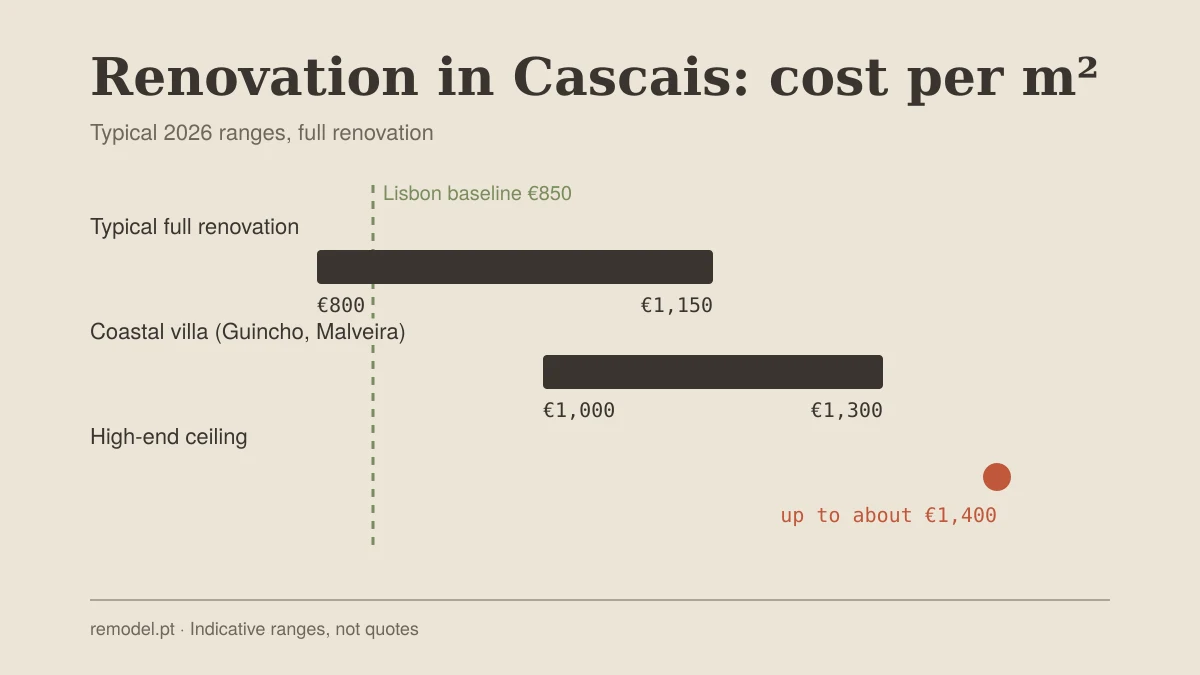
What's in this guide
- Cascais full renovations run €800 to €1,150/m², and coastal villas €1,000 to €1,300/m²
- Since 1 October 2026 most works follow comunicação prévia, filed through MyCascais by an architect or engineer
- Plots near Guincho can fall under Natural Park (POPNSC) and coastal programme (POC-ACE) limits
- Gated estates in Birre and elsewhere often add their own architecture review before the câmara
- A project manager usually pays off above roughly €100,000 or when the owner lives abroad
What makes renovating in Cascais different from Lisbon?
The municipality runs from the Carcavelos and Parede seafront through Cascais and Estoril to Birre, Alcabideche and the Atlantic coast at Guincho. Prices sit above Lisbon, but the bigger difference is what has to be checked before anyone draws a line.
Three questions decide most projects. What is the property: an apartment, a villa, or an older house with unclear paperwork? Does it sit inside a gated community or condominium with rules of its own? And does any part of the plot touch the Sintra-Cascais Natural Park or a coastal protection strip? Owners who ask these first avoid the expensive surprise later.
How much does it cost to renovate a house in Cascais?
Cascais generally sits 10 to 20% above the Lisbon baseline. The three ranges describe different things, which is why they do not match. €800 to €1,150 is the typical full renovation. €1,000 to €1,300 reflects coastal villa stock around Guincho and Malveira, where marine-grade fixtures, longer service runs and exterior works add cost. The ceiling of about €1,400 is a high-end finish in central Cascais or Lisboa.
| Property type | Cost per m² | Worked example |
|---|---|---|
| Apartment, standard full renovation | €800 to €1,150 | 120 m²: €96,000 to €138,000 |
| Coastal villa (Guincho, Malveira) | €1,000 to €1,300 | 250 m²: €250,000 to €325,000 |
| High-end finish, central Cascais | Up to about €1,400 | 250 m²: up to about €350,000 |
What permit do you need to renovate in Cascais?
Portugal uses one national framework, the RJUE (Decreto-Lei 555/99), reformed by DL 108/2026 from 1 October 2026. Cosmetic work needs no filing. Most other renovations go through prior notification (comunicação prévia), and a full licence (licenciamento) is kept for a narrower set of cases. Our renovation permit guide explains the bands, and the permit process guide covers the reform. Ask the Câmara Municipal de Cascais which route your case follows. What is specific to Cascais is how you file.
Applications go through the câmara's online portal, MyCascais. The owner, the architect or engineer (registered with the Ordem dos Arquitectos or Ordem dos Engenheiros) and any representative must each be registered and validated there first. You then draw the site on the GeoCascais map, upload the documents and pay by Multibanco reference. According to the câmara's own help notes, written documents must be PDF/A and drawings DWFx, both digitally signed with the Cartão de Cidadão. You cannot step back through the form, so the technician should have everything ready before starting.
Legal decision windows are set by law, not by the portal, so use the permit process guide for planning and ask your architect how recent Cascais filings of your type have gone.
Is your plot inside the Natural Park or a coastal protection strip?
Two layers apply on top of the ordinary permit rules. The first is the Sintra-Cascais Natural Park plan (POPNSC). Works on rural land inside the park can require an opinion from ICNF, and the area is also part of the Sintra/Cascais Special Conservation Area in the Natura 2000 network.
The second is the coastal programme for the Alcobaça to Cabo Espichel coast (POC-ACE), which Cascais built into its master plan (PDM) in 2019. In the coastal protection strips, new buildings are prohibited and most extensions are too. Conservation, demolition and reconstruction that does not raise the façade can still be authorised. Cliff and instability strips add further limits, and new basements are banned in flood zones on sandy coasts. Where the park and the coastal programme overlap, the stricter rule applies, and lawfully existing buildings can keep established rights, subject to safety conditions.
What should you check first, area by area?
These are starting points, not a substitute for checking your plot.
- 01Cascais centre, Estoril, Parede and Carcavelos
Mostly apartments and older villas. Read the condominium (condomínio) rules first: the administrator or assembly may need to approve façade, window and structural changes, and the building sets working hours. Older villas in Estoril and central Cascais often raise the 1951 rule and the habitation licence.
- 02Birre, Alcabideche and gated estates
Detached villas, often inside a gated community with its own architecture review board in addition to câmara approval. Ask for the community rules and the approval timetable before you commission drawings, because this review can add weeks to the permit stage.
- 03Guincho, Cresmina and Malveira
Coastal and countryside houses. Confirm whether the plot is inside the Natural Park or a coastal protection strip, and budget for marine-grade fixtures and longer service runs.
- 04Houses with unclear paperwork
Any villa with extensions nobody can document. Order the property file (caderneta predial and the land registry certificate) and check what is legalised before you scope anything. Unlicensed additions can complicate a permit.
How long does a renovation take in Cascais?
Those figures are build time only. Before the build comes the design, the câmara filing and, in a villa, any community or park review. Our permit guide plans for roughly 2 to 6 months from first survey to start of work on a typical renovation, and a villa with structural changes, a community review or park limits sits toward the longer end. The permit process guide sets out the legal windows.
A common mistake is to book contractors for a start date the permit cannot meet. Sequence it the other way round: prior information, design, permit, then tender.
Do you need a project manager for a villa in Cascais?
Most Cascais villa projects have an architect who designs and a contractor who builds, but nobody whose job is to coordinate the structural, electrical, plumbing and tiling trades, check variations and sign off payments. A construction project manager (gestor de projeto de obra) fills that gap on the owner's side.
Our guide to whether you need one sets out when it is worth it, and the project manager cost guide explains how fees work. Whoever you choose, get the services, the visit frequency and any contractor referral fees in writing.
How does remodel.pt match contractors for Cascais projects?
We match you with personally vetted local contractors and get you competitive quotes to compare, completely for free. English communication is part of the vetting, directly or through a project manager.
For villas, the licence class matters: a general contractor's alvará should cover the value of the works, which you can check against the IMPIC registry. Our general contractors in Cascais page explains the standard, and the contractor due diligence checklist gives you the questions to ask. Request quotes against one written scope, so prices compare line by line.
Frequently asked questions
Conclusion
Renovating a house in Cascais is mostly a question of the plot: its type, its community rules, and whether the park or the coast limits what you can change. Costs run 10 to 20% above Lisbon, and the permit stage deserves as much planning as the build.
Ask the plot questions before you design, price one written scope with competitive quotes, and decide early who runs the site.
- Câmara Municipal de Cascais: MyCascais help notes (FAQ)
- Aviso n.º 13041/2019: Cascais PDM adapted to the POC-ACE coastal programme
- Example ICNF opinion for a Cascais plot (Natural Park and Natura 2000)
- Diário da República: DL 108/2026 (RJUE reform)
- IMPIC: contractor licensing
Related reading: Do you need a permit to renovate?, Villa renovation cost, Project manager cost, Renovating in Oeiras

Kellogg is a former payments executive turned entrepreneur, with a family background in real estate. He has spent the past year bringing that experience to the Portuguese property market, and co-founded remodel.pt to apply the same rigor to how contractors are vetted.