
Builder vs contractor vs project manager in Portugal: who do you need?
Roles overlap, terms get used loosely, and the person quoting you isn't always the person who should be overseeing the job. Here is how to work out who your renovation actually needs.
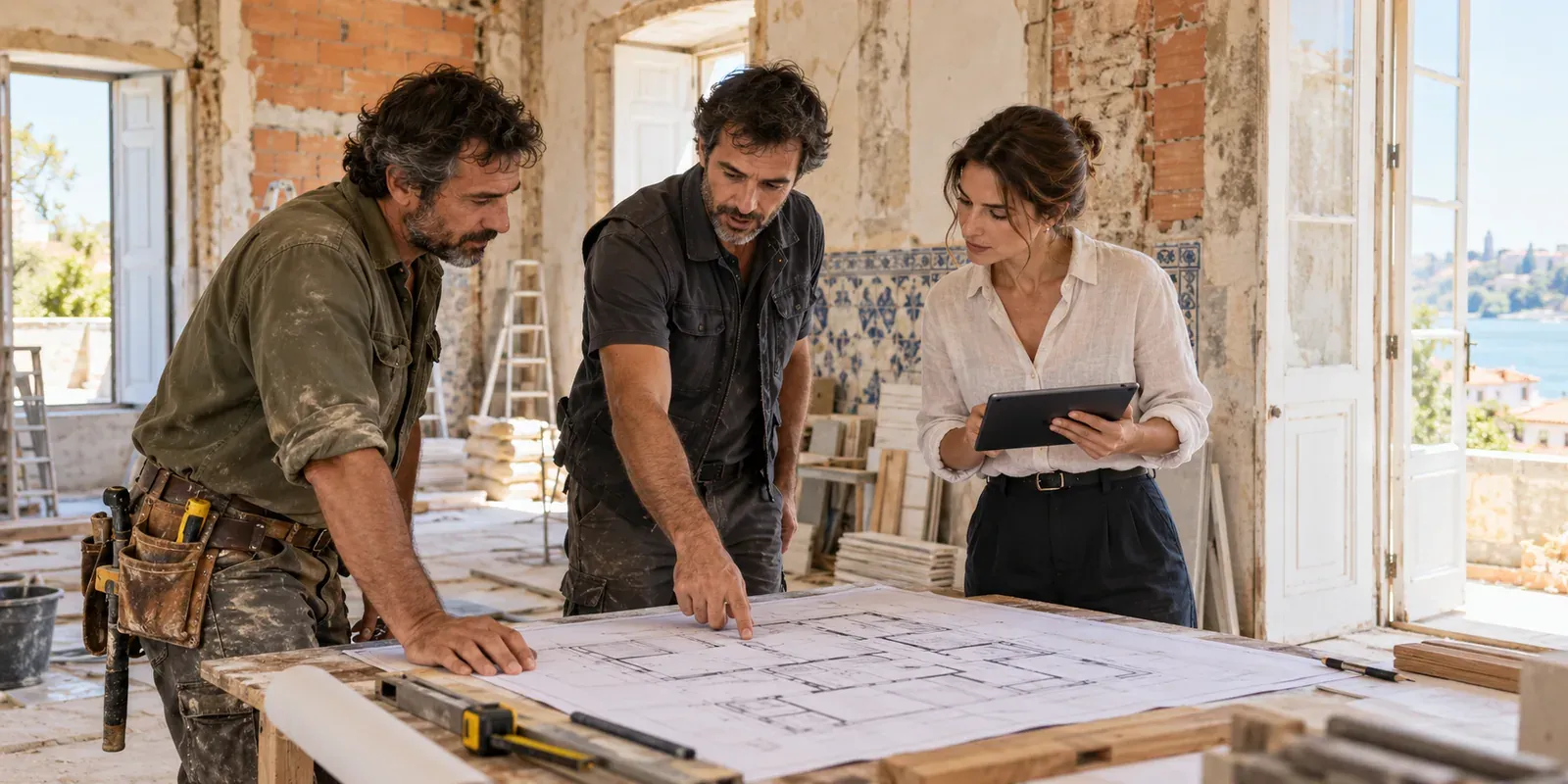
Small jobs need a tradesperson, straightforward renovations a general contractor, and larger or remote projects an independent project manager, plus architects or engineers where design or approvals require them.
In this guide
- The roles
- The simple answer
- What is a builder?
- What is a general contractor?
- What is a project manager?
- Contractor vs project manager
- Can the contractor also manage it?
- What about an architect?
- And engineers?
- Diretor de obra and fiscalização?
- Who should obtain the permits?
- Your project
- Which structure is right for you?
- Do you always need a project manager?
- Should your PM be independent?
- Hiring
- Questions to ask before hiring
- A quote is not a project plan
- So who do you actually need?
- Frequently asked questions
Who actually makes your renovation happen?
Overlapping roles and loose terminology make it easy to choose the wrong structure, which leads to poor coordination, extra cost, delays and unclear responsibility.
You have a property in Portugal that needs renovating. Now you need someone to make it happen. A builder? A general contractor? A project manager? An architect? All of them?
For foreign owners the Portuguese market is hard to read. Roles overlap, terminology isn't used consistently, and the person who gives you a quote isn't necessarily the person who should be independently overseeing the project.
So before you ask for quotes, work out who you actually need.
The simple answer
The contractor delivers the construction work, the project manager manages the project, and the architect designs and defines the technical solution.
Builds what has been agreed: labour, trades, materials, site.
Coordinates, monitors and reports, ideally on your behalf.
Layout, drawings, technical documentation, approvals.
How many of them you need depends mostly on the size and complexity of the job:
- Small jobTradesperson or contractor
- Straightforward renovationGeneral contractor managing the trades
- Larger or complexContractor plus independent project manager
- Design, structure or approvalsAdd architects and engineers
Real projects aren't always that clean. Here is each role in turn.
What is a builder?
"Builder" is a broad term covering anyone from an individual tradesperson to a company able to deliver a whole renovation.
"Builder" describes a type of person, not how your renovation will be structured. A builder may be:
On a small apartment, a builder might personally handle demolition, walls, plastering, tiling, flooring and painting, while bringing in subcontractors for plumbing and electrics.
When might a builder be enough?
The project
- The scope is relatively simple
- Few trades are involved
- Little design work is needed
You
- You understand the project well
- You can visit the property regularly
- You're comfortable making decisions yourself
The larger and more complicated the project, the more coordination matters.
What is a general contractor?
A general contractor takes responsibility for a broader scope and coordinates all the trades, giving you one commercial relationship instead of six or seven.
Instead of hiring each trade yourself, you contract with one company that coordinates them to deliver the agreed works.
A general contractor may be responsible for:
For a well-defined renovation this can work very well. There is one important distinction.
The contractor is responsible for delivering the work. They are not necessarily your independent representative.
What is a project manager?
A renovation project manager coordinates the whole project on the owner's behalf, from scope and quotes through budget, progress, variations, snagging and handover.
A renovation project manager coordinates the project for the property owner. Their job is different from the contractor's.
Deliver the work we've agreed to deliver.
Make sure the overall project is being delivered properly for the owner.
Depending on the agreed scope, a project manager might help with:
Before work starts
- Defining the project scope
- Obtaining and comparing quotes
- Building the budget
- Creating a programme
During the works
- Coordinating contractors and suppliers
- Coordinating architects and engineers
- Attending the property
- Monitoring progress
- Reporting back to you
- Identifying delays or problems
Money and completion
- Reviewing payment milestones
- Managing variations
- Monitoring costs
- Organising snagging
- Managing completion and handover
For an overseas owner, this can be particularly valuable.
Contractor vs project manager: who is checking?
The contractor has a commercial interest in progressing and being paid. An independent project manager should verify progress on the owner's behalf.
Imagine you're renovating a villa in Cascais. The contractor messages you:
You are in London, Paris, New York or Zurich. What do you do?
That is one of the fundamental reasons independent project management can be valuable. The contractor has a commercial interest in progressing the work and getting paid. An independent project manager should be working for you, the property owner. That distinction matters more as the project gets bigger.
Can the contractor also manage the project?
Yes. A good contractor manages their own construction. The real question is who manages the project from your side, which matters more as budgets grow.
Yes, and for many projects that's perfectly reasonable. A competent general contractor should already manage their own team, subcontractors, materials and programme. The question isn't whether the contractor manages the construction. They should. The question is:
Who is managing the project from your side?
- A separate project manager may be unnecessary
- A good contractor and a clear contract can be enough
- Architects, structural work, multiple suppliers, a significant budget
- Relying only on the company doing the work means less independent oversight
What about an architect?
An architect handles design and technical development. A project manager doesn't replace one; on larger projects the two roles complement each other.
A project manager is not a replacement for an architect. An architect's role generally relates to the design and technical development of the property, and may include:
For a cosmetic renovation you may need little architectural involvement. For major alterations, extensions, structural changes or projects requiring formal approvals, professional architectural and engineering input may be essential.
And what about engineers?
Structural, electrical, mechanical and energy engineers may be required. Don't let your builder make every technical decision on structural or systems work.
Some renovations need specialist engineering expertise:
If you're removing walls, changing structural elements, extending or substantially modifying building systems, don't assume your builder should make every technical decision. Use appropriately qualified professionals.
What are the diretor de obra and the diretor de fiscalização?
Licensed works need a qualified diretor de obra on the contractor side and a diretor de fiscalização de obra checking the works for the owner. A project manager does not replace either role by default.
The diretor de obra is responsible for technical execution and keeps the site logbook. The diretor de fiscalização verifies that the work follows the approved project. Both can carry legal responsibility for breaches, together with other parties, so you should know who they are.
The details depend on the type of works and on the current RJUE (the legal framework for urban development and building), so confirm with your architect or câmara municipal. The qualifications are set in the law on professional qualifications for projects and works (Lei 31/2009, as amended by Lei 40/2015). “Project manager” has no legal definition in Portugal, so ask whether the person is also qualified to be appointed to one of these roles.
Who should obtain the permits?
Permit responsibility can sit with the architect, project manager, contractor or owner. Agree and document it before the project begins.
This should be settled before the project begins. Responsibility may sit with the architect, project manager, contractor, owner, or a combination. The important thing is not to assume. Ask:
Does this project need municipal approval or another formal process?
Who is responsible for determining that?
Who prepares the documentation?
Who submits it?
Who communicates with the authorities?
Can construction legally begin before approval?
Then document those responsibilities in the contract. Our guide to what a Portuguese renovation contract should include covers how.
Which structure is right for your renovation?
The team grows with the job: a tradesperson for repairs, a contractor for small renovations, and architects, engineers and project management for full or villa renovations.
There isn't one answer for every project. This is how the team typically grows with the job.
| Project | Tradesperson | General contractor | Architect / designer | Engineers | Project manager |
|---|---|---|---|---|---|
| Small repair or maintenancePlumbing fix, painting rooms, a small area of flooring, minor electrics | |||||
| Small renovationBathroom, kitchen or cosmetic apartment refurbishment | |||||
| Full apartment renovationKitchen, bathrooms, floors, electrics, plumbing, windows, HVAC, layout changes | |||||
| Major villa renovationStructural alterations, new systems, exterior works, landscaping, pool | |||||
| Renovating from outside PortugalAny of the above, when you can't visit the site regularly |
Tradesperson or specialist
You probably don't need an independent project manager.
You probably needAn individual tradesperson or specialist contractor
Builder or general contractor
A separate project manager may or may not be worth it, depending on value, complexity and your ability to oversee.
You may needBuilder or general contractor, plus specialist trades
Design plus delivery
The more trades and suppliers involved, the greater the coordination requirement.
You may needArchitect or designer, general contractor, potentially a project manager
A construction team
This is no longer "hiring a builder". You're managing a significant construction project.
PotentiallyArchitect, engineers, general contractor, independent project manager, specialist suppliers
Renovating while living outside Portugal
This deserves its own category. If you're based overseas and can't visit regularly, project management becomes much more valuable. You need someone who can:
Otherwise you can end up trying to manage a six-figure construction project through WhatsApp.
Do you always need an independent project manager?
No. On a simple job it adds cost. On a large budget, the cost of poor management can outweigh it, so weigh both.
No. Adding professionals adds cost. For a straightforward €20,000 renovation with a trusted contractor, a separate project manager could be unnecessary.
But as value and complexity grow, the economics change. Suppose you're spending €200,000. A small percentage of overspend from any of these adds up fast:
What overspend costs on a €200,000 renovation
Simple arithmetic for illustration, not a forecast.
So the question isn't only "how much does a project manager cost?"
What is the cost of managing this project badly?
Should your project manager be independent from your contractor?
Combined build-and-manage models can work, but if you want independent oversight your project manager must be free to challenge the contractor.
Some renovation businesses provide construction and project management together. There is nothing inherently wrong with that; one organisation responsible for everything can make delivery easier. But understand the commercial relationship.
If you want independent oversight, your project manager needs enough independence to challenge:
Before appointing anyone, ask:
Who is this person representing?
What to ask a contractor, and a project manager
Don't choose on the cheapest quote. Ask about licensing, insurance, references, payment and reporting, and ask a project manager who they represent and how they're paid.
Don't select a contractor because their quote is cheapest, and understand exactly what you're paying a project manager to do. The answers often tell you more than the quotation.
Ask the contractor
- Are you appropriately licensed for this work where required?
- What insurance do you carry?
- Can I see examples of comparable projects?
- Can I speak with previous customers?
- Who will manage my project day to day?
- Who will actually be working on site?
- Which parts will be subcontracted?
- How will additional work be approved?
- What payment schedule do you propose?
- How will progress be reported?
- What happens if the project is delayed?
- How will snagging and final completion work?
Ask the project manager
- How often will you visit the site?
- How will you report progress to me?
- Will you help obtain and compare contractor quotes?
- Will you monitor the project budget?
- Will you review variations?
- Will you review contractor payment requests?
- Will you coordinate architects, engineers and suppliers?
- Will you manage the programme?
- Will you oversee snagging?
- Who are you contractually representing?
- How are you paid?
- Do you receive fees or commissions from contractors or suppliers?
Depending on the nature and value of the works, contractors may need an appropriate alvará or certificate. You can verify credentials with IMPIC.
Don't confuse a quote with a project plan
A quote is a price. A renovation plan also defines scope, design, responsibilities, specifications, programme, payments, variations, quality control, approvals and completion.
It feels like a plan. It's a price.
The larger the project, the more dangerous it is to start construction without these properly defined. Most of them belong in the contract itself.
Turn the quote into a contractPortuguese renovation contract: what should be included?So who do you actually need?
Match the team to the job: tradesperson, then general contractor, then contractor with design and project management, then local representation if you're overseas.
- Simple workThe right tradesperson or specialist contractor
- Straightforward renovationA general contractor who coordinates the work
- Complex renovationContractor, architect or engineers, plus project management
- High value, you're overseasSomeone local representing your interests
The right answer depends on your property, location, scope, budget and how involved you want to be.
Frequently asked questions
QWhat is the difference between a contractor and a project manager in Portugal?
The contractor delivers the construction work and has a commercial interest in being paid for it. An independent project manager works on behalf of the owner, coordinating the project and verifying progress.
QDo I need a project manager for my renovation in Portugal?
Not always. For small or straightforward jobs a good contractor may be enough. Independent project management becomes more valuable as budget, complexity and distance from the property increase.
QCan the contractor also manage the project?
Yes. A competent contractor should manage their own team, subcontractors, materials and programme. The question is who manages the project from the owner's side.
QDo I need an architect to renovate in Portugal?
For cosmetic work you may need little architectural input. For major alterations, extensions, structural changes or works requiring formal approvals, architects and engineers may be essential.
QWho is responsible for renovation permits in Portugal?
It depends on the project. Responsibility can sit with the architect, project manager, contractor, owner or a combination, so agree and document it before work begins.
QWhat is the difference between a builder and a general contractor?
Builder is a broad term covering anyone from an individual tradesperson to a full renovation company. A general contractor takes responsibility for a broader scope and coordinates the trades needed to deliver it.
QI live outside Portugal. Who should oversee my renovation?
If you cannot visit regularly, consider someone local who represents your interests: visiting the site, reporting progress, verifying milestones and escalating issues.
QWhat should I ask a project manager before hiring them?
Ask how often they visit, how they report, whether they review variations and payment requests, who they contractually represent, how they are paid and whether they receive fees or commissions from contractors or suppliers.
QDo I need a diretor de obra and a diretor de fiscalização?
For licensed works the law requires qualified technicians in these roles. The exact requirements depend on the works and the current RJUE, so confirm with your architect or câmara municipal. A project manager does not replace them unless he is also a qualified technician appointed to the role.
QWho pays the project manager?
The owner pays, usually a percentage of the build cost (typically 7.5% to 15%). The fee should be written down, and any referral fee the project manager receives from contractors should be disclosed in writing.

Kellogg is a former payments executive turned entrepreneur, with a family background in real estate. He has spent the past year bringing that experience to the Portuguese property market, and co-founded remodel.pt to apply the same rigor to how contractors are vetted.
This article provides general information about renovation projects in Portugal. The professionals, licences, approvals and technical requirements needed will depend on the nature, location and scope of each project. Obtain appropriate professional and legal advice for your specific circumstances.
Last updated 7 October 2026