
Investing in Portugal's older buildings: a renovation cost guide for 2026
By Kellogg Fairbank · Co-founder of remodel.pt · Last updated August 2026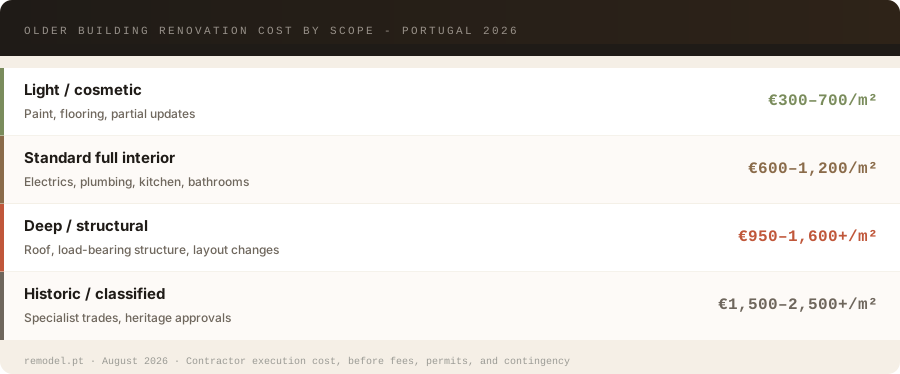
What's in this guide
- Renovation costs for older stock range €600–€1,200/m² for standard work, €1,500–€2,500+/m² for heritage-compliant projects
- A construction licence (licenciamento) from the câmara municipal takes 60–120 days for structural work on older buildings
- Reduced VAT (IVA) at 6% instead of 23% applies to qualifying rehabilitation in most Áreas de Reabilitação Urbana (ARU)
- Contingency should run 15–20% minimum on standard stock antigo, and 25–40% on ruins or classified buildings
- Unscoped renovations without an independent survey overrun budgets by 20–40% on average
Why older Portuguese buildings still make financial sense
That upside is real, but it belongs almost entirely to buildings in high-demand urban zones, the same stone, timber-joisted apartments in low-demand interior towns rarely return their renovation spend.
The appeal for foreign owners is straightforward: Portugal has an unusually large inventory of pre-1950s and pre-1990s residential stock, much of it structurally sound but functionally outdated. Unlike new-build, this stock is priced for its condition, not its location, which is exactly where the margin lives, provided the renovation is scoped and budgeted correctly. The trap is that "correctly" requires local construction knowledge most foreign buyers don't have, and that gap is where quotes 20 to 40% above local rates and unscoped structural surprises both originate.
The margin in stock antigo sits in the gap between purchase price and correctly-scoped renovation cost, which is exactly where an independent survey and benchmarked quotes protect the number that matters.
What does an older-building renovation actually cost?
Cosmetic work sits at €300–€700/m², deep structural or full-gut projects run €950–€1,600+/m², and heritage-compliant renovation on classified buildings can reach €1,500–€3,800/m².
| Scope | €/m² | Typical inclusions |
|---|---|---|
| Light / cosmetic | €300–700 | Paint, flooring, partial updates |
| Standard full interior | €600–1,200 | Electrics, plumbing, kitchen (from €28,000), bathrooms (from €12,000) |
| Deep / structural | €950–1,600+ | Roof, load-bearing structure, layout changes |
| Historic / classified | €1,500–2,500+ (up to €3,800+) | Specialist trades, heritage approvals |
Lisboa and Porto typically add 20 to 40% to labour costs versus secondary cities. On top of contractor execution costs, budget 8 to 12% for project fees and site supervision, and treat acquisition costs (IMT, stamp duty, notary, typically 7 to 11% of purchase price combined) and 12 to 18 months of carrying costs as separate line items, not afterthoughts.
Against a post-renovation value typically €580,000–€620,000, the flip margin is thin; the long-term rental case (roughly 4 to 5% gross yield on all-in cost) is usually the stronger argument.
Why do renovation budgets on stock antigo overrun so often?
Rotten timber joists, rising damp, unstable stone walls, outdated electrics, and, in some older buildings, asbestos are common findings that a €1,000–€2,500 structural survey catches before contract, not after demolition has started.
Budgeting from a viewing instead of a technical survey is the single biggest driver of cost overruns on stock antigo, structural and damp issues found after contract are far more expensive than the same findings before it.
Two other patterns drive overruns specifically for foreign owners:
Over-specifying for the local market
Importing a domestic-market finish level into a low-demand interior town spends money the eventual sale or rent will never recover.
Tightening energy rules
EPBD-related energy performance requirements are increasingly restricting the future rental or sale of poor-performing older stock, insulation, windows, and heat pumps are becoming de facto scope, not optional extras.
The fix on both counts is the same: a written scope from a qualified architect or engineer, 2 to 3 comparable contractor quotes benchmarked against each other, and contingency of 15 to 20% minimum on standard stock antigo, rising to 25 to 40% on ruins or classified buildings.
What tax incentives apply to older building renovation?
That reduction alone can run into tens of thousands of euros on a mid-sized project. Recent measures under the 2025 to 2029 Construir Portugal package and Decree-Law 97/2026 have broadened eligibility for residential rehabilitation aimed at housing or long-term rental.
6% IVA applies to qualifying rehabilitation under ARU designation or on buildings over 30 years old; IMI exemptions (typically 3 years+) and possible IMT relief in ARU zones can apply alongside energy-efficiency grants via Fundo Ambiental.
One caution worth flagging directly: the old Golden Visa renovation-investment pathway was largely closed by the 2023 Mais Habitação reforms, so a renovation project should be underwritten on its own returns, not on a residency benefit.
How does remodel.pt protect your budget on older stock?
That inspection documents structural condition, damp, and code compliance before a single quote is accepted. We personally match you with a vetted local contractor who sends you a detailed, itemised quote, completely for free, benchmarked against the regional median for that project type, the same protection against 20 to 40% overpricing this guide recommends sourcing independently, built into the process.
Scope
Photos, dimensions, finishes, English form, English support.
Quotes
Matched with a personally vetted local contractor for competitive, benchmarked quotes, free.
Inspection
Independent condition report establishes baseline before work begins.
Payment
Staged milestones signed off by you and the inspector before each release.
Once work begins, payments release in stages, tied to milestone sign-off by you and the independent inspector rather than to the contractor's own timeline, which is the direct answer to the distance problem foreign owners face when they can't be on-site to catch a corner being cut.
Frequently asked questions
Conclusion
Portugal's older building stock still delivers real upside for foreign owners willing to budget it properly: a technical survey before purchase, contingency of at least 15 to 20%, and quotes benchmarked against regional medians rather than accepted on faith. The projects that go wrong almost always skipped one of those three steps.
Related reading: Portugal renovation costs 2026 by region · Renovating in Oeiras · IMI after renovation · Vetted vs. verbal quotes

Kellogg is a former payments executive turned entrepreneur, with a family background in real estate. He has spent the past year bringing that experience to the Portuguese property market, and co-founded remodel.pt to apply the same rigor to how contractors are vetted.